The Compressor and the Small Black Hole
AC: Air Conditioner, the machine that cools a room while making sounds like an elderly taxi clearing its throat.
NASA: National Aeronautics and Space Administration, the American space agency that gives black holes better publicity than most human beings get.
CRISPR: Clustered Regularly Interspaced Short Palindromic Repeats, a gene-editing method borrowed from bacterial defense systems.
AI: Artificial Intelligence, software systems that imitate parts of human reasoning, language, pattern recognition, or stupidity, depending on the day.
The AC compressor starts outside my wall with a metallic cough, and for three seconds my brain stops prosecuting me.
This is not a small thing.
In my present condition three seconds of silence inside the head is not silence. It is Switzerland. It is a ceasefire. It is the local tea shop suddenly accepting credit from a man whose finances look like a collapsing bamboo scaffold in the rain.
My eyelids sit on my eyes like two damp municipal files. The room is dim. The air has that Calcutta heaviness, half weather, half punishment. Somewhere a pigeon is walking on a ledge with the moral confidence of a retired clerk who has never admitted a mistake in his life.
And inside my skull, as usual, the case begins.
Unfinished.
Unpaid.
Uncalled.
Uninvited.
Unkissed.
Unprofitable.
Unimproved.
A whole list of small humiliations arrives, each one holding a stamped paper, each one asking for a signature.
Then the compressor coughs.
For a moment the court is adjourned.
Then it starts again.
Not thought exactly.
Thought has legs. Thought walks somewhere. Thought says, let us go from here to there. Let us begin with rice and end with a washed plate. Let us begin with shame and end with a bath. Let us begin with one sentence and end with one paragraph that does not look as if it was dragged behind a bus from Behala to Barasat.
What I have now is not thought.
It is circulation.
Round and round it goes. Warm. Murky. Accusing. Bits of old life float in it. American highways. Hospital corridors. Old exam ranks. Old rooms. Old hopes wearing torn slippers. Old faces that had the decency to leave but not the decency to fade.
Sometimes one bright idea flashes in the muck like a fish in a dirty pond.
Ah, I think. There you are. The old brain has not completely become overboiled lauki.
Then a pump starts somewhere in the building, a pipe knocks inside the wall, someone drags furniture upstairs, and the fish vanishes.
People call this blur.
No.
Blur is too pretty. Blur is rain on glass. Blur is an old film heroine looking out of a window while history puts powder on her face.
This is dimming.
This is a tube light in a government office losing voltage while everyone responsible for fixing it has gone for tea, lunch, leave, retirement, or philosophy. The desk is still there. The file is still there. The chair is still there. The nation may have a space program, nuclear missiles, online delivery apps, mythological confidence, and six kinds of political shouting before breakfast, but it cannot produce one steady rectangle of light over one tired wooden table.
That is the mind now.
A flicker.
A delay.
A fan that turns but does not cool.
The cruel part is that clarity remains.
This is where people misunderstand depression. They imagine confusion. They imagine a man forgetting his name, putting the toothbrush in the rice cooker, calling the landlord Ma, and wandering into traffic with one sock on. That happens to some people, yes, and it is terrible.
But there is another version.
The lights dim, but the wiring still knows what electricity is.
I can still explain things if asked. I can still follow a science video about black holes, gene editing, robots, protein folding, or the mathematics that allows human beings to turn confusion into diagrams and then sell the diagrams to one another in conferences with stale sandwiches.
I can still understand.
I just cannot aim myself.
That is the problem.
Intent has leaked out.
The small muscular pleasure of finishing a thing has disappeared. Closing a loop. Ending a task. Turning an open bracket into a closed one. These once felt ordinary. Now they feel like public works projects requiring permits, bribes, supervision, rain delays, and one man named Bappa who promised to come yesterday.
A man can survive sadness.
People do it daily. They tuck sadness under their shirt like a second sweaty vest and go to office. They buy coriander. They say “haan, haan” on the phone. They pretend to listen to relatives. They come back and sleep under a fan making the sound of a retired helicopter.
But purposelessness is different.
Purposelessness is not sadness.
It is a small black hole in the chest.
Not the glamorous NASA kind, with blue rings and clean mathematics and the kind of lighting that makes catastrophe look expensive. Mine is a domestic black hole. A Calcutta black hole. It sits near the plug point in a lungi and quietly swallows spoons, unpaid invoices, half-written drafts, socks, desire, dignity, and the last biscuit in the packet.
Darkness is not the scary part.
Many things are dark. The inside of a pressure cooker before rice. The corner behind the bathroom bucket. The moral imagination of a property broker. Darkness is cheap.
The terror of a black hole is that it bends the path of things.
Even light goes in and cannot come out.
So imagine what happens to willpower, which was never light, never fast, never heroic. Mine is not a laser beam. It is a small village goat tied to a post of habit, chewing whatever dry grass history has left.
It gets pulled inward.
Tea becomes a project.
Bathing becomes a military operation.
Replying to a message becomes foreign policy.
Opening a document becomes archaeology.
And sleep, which should have been the body’s socialist redistribution scheme, taking from the rich hours of wakefulness and giving to the poor exhausted cells, turns into a private cinema run by lunatics. Flashbacks. Regrets. Old rooms. Unpaid bills. Women one thought might understand something. Men one should have answered more sharply, but did not, because one was educated and therefore badly equipped for local combat.
I lie down to rest and wake with sadness already sitting beside me like a relative who arrived early and brought no sweets.
Some mornings the fatigue does not feel like fatigue.
It feels like an order.
Lie down.
Curl up.
Stop.
The body says it plainly. No poetry. No ideology. No inspirational poster. Just the old mammal instruction, older than Sanskrit, older than Marx, older than the British, older than every brass bell ever rung by civilization to announce its own importance.
Become small.
Become warm.
Become harmless.
Let the world pass.
And the world does pass. Buses groan. Pumps start. Pigeons land with comic seriousness. Car horns bloom like seasonal disease. WhatsApp pings. Someone on the lane shouts into a phone as if Alexander Graham Bell invented the device so one Bengali uncle could discuss cement delivery at 8:17 in the morning with the emotional range of a courtroom drama.
The noises save me and insult me.
A car reverses with that shrill electronic beeping, the mating call of urban anxiety.
The AC coughs.
A pressure line knocks.
Something falls upstairs.
A child screams.
A woman drags furniture.
A dog offers a long legal argument against existence.
Each sound punctures the monologue for a second, and in that second I am nearly free. Not happy. Let us not become extravagant. Happiness is now a luxury item, like imported cheese, dental implants, or a landlord who repairs things without behaving like a wounded freedom fighter.
But I am displaced from myself.
That is something.
For a second I am evicted from the courtroom inside my skull, where I am always both accused and judge. The evidence is produced from 1975 onward.
Exhibit A: wasted promise.
Exhibit B: returning to India.
Exhibit C: intelligence that refuses to become money.
Exhibit D: belly, baldness, bad teeth, panic, unpaid work, and the whole wet file tied in red tape.
Then silence returns.
The trial resumes.
There is a little science here, although science deserves better than being dragged into my room like a respectable professor asked to inspect a clogged drain.
The brain is not one king sitting on a throne. It is a noisy committee. Wanting systems. Alarm systems. Memory clerks. Sleep janitors. Hormone messengers carrying bad news in envelopes of blood. One department says move. Another says danger. Another says remember that humiliation from 1994. Another says eat. Another says don’t eat. Another says why are we alive. Another has gone on tea break and taken the keys.
Purpose is chemistry wearing a philosophical hat.
Motivation is not character. It is not morality. It is not your grandmother’s proverb. It is a biochemical credit line. When the bank closes, your grand plans become bounced cheques.
This is why advice can be so useless.
“Just do it.”
Do what?
With which fuel?
With which clean circuit?
With which morning?
People talk about discipline as if it is a bamboo stick one can buy from Gariahat and beat oneself into productivity with. They do not understand that sometimes the stick is also tired. Sometimes the hand holding the stick has gone numb. Sometimes the whole man has become an abandoned tram depot, weeds growing through the tracks while one goat chews the timetable of 1983.
And yet some functions remain.
This is the strange part.
I can watch news, which is basically drinking concentrated public sewage and then complaining of stomach trouble.
I can watch young people on the internet explain dark energy, robotics, AI, gene editing, and the future with the shining confidence of people whose electricity, stomach, teeth, and banking arrangements appear to have reached a peace treaty.
I can read, sometimes.
I can write, sometimes.
I can retype old things, which is pathetic but also tender, like washing the body of a former ambition before cremation.
There are days when moving one sentence from here to there feels like lifting a stone from a grave.
There are days when I still admire a phrase, a clean explanation, a joke that lands properly, the little click of an idea fitting into the mind. And then I think, perhaps not everything has been eaten.
Then the vacuum returns.
Not emptiness.
Emptiness can be beautiful. A clean empty room. A blank page. A quiet road at dawn before the tea stalls open and the city remembers its bad habits.
This is not that.
This is vacuum as suction.
A black inward weather.
It pulls taste out of food, flirtation out of memory, ambition out of skill, future out of calendar, and makes the body feel like rented equipment.
So I sit with the heaviness behind my eyes and wait for the AC to start again.
That is how grand the ambition becomes.
Not career.
Not love.
Not triumph.
Not revenge.
Only the compressor.
A mechanical lung outside the wall, deciding after some humid hesitation to breathe.
And when it does, the room trembles faintly. The air shifts. The skin cools. The mind is interrupted. For a few seconds I am merely a man in a room.
Not a case history.
Not a failed son of meritocracy.
Not lunch for the black hole.
Not the clerk of my own prosecution.
Then a pigeon makes a sound on the windowsill like a priest with constipation, and I laugh once, very softly, like a cracked cup remembering tea.
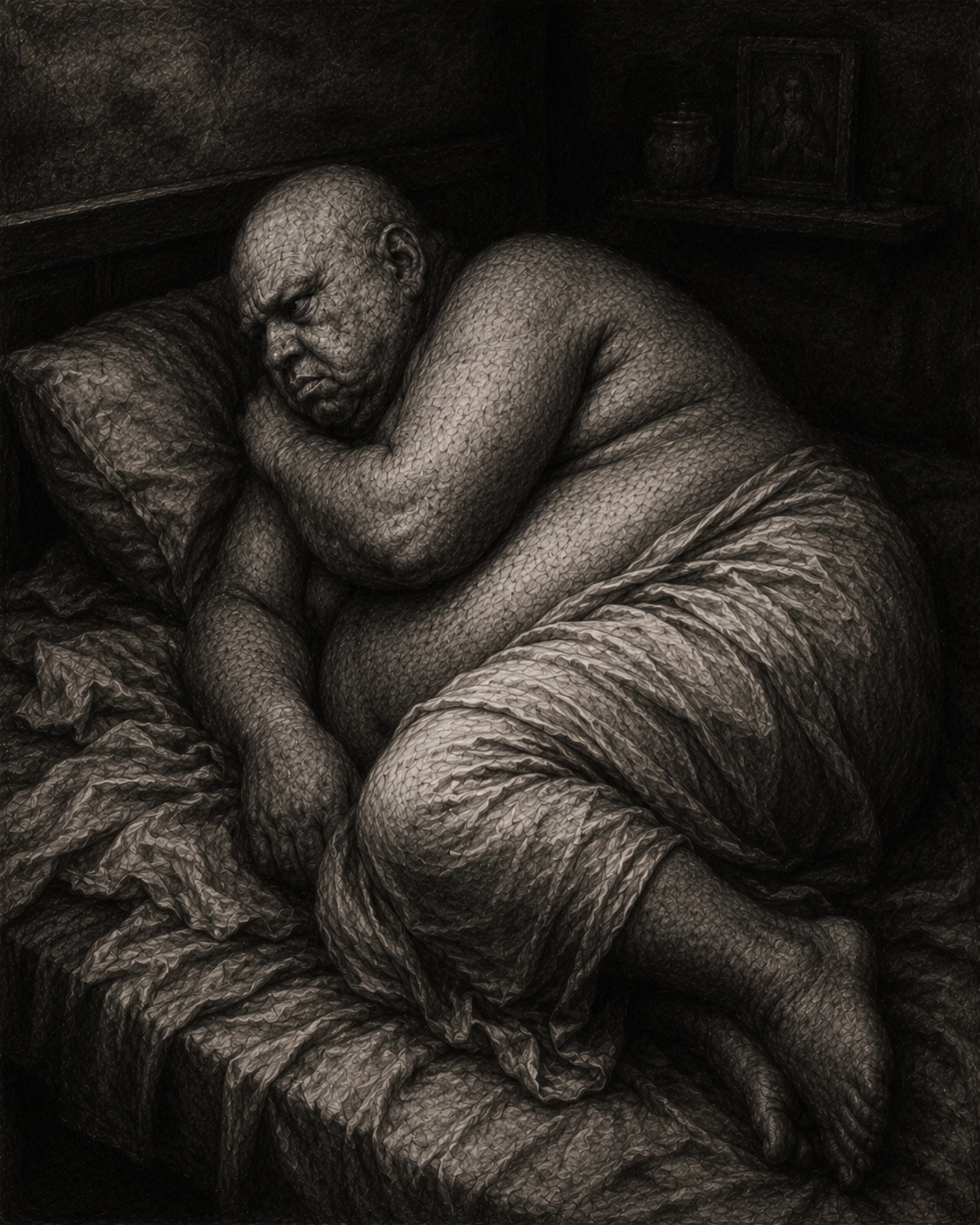
After that I lie down again, one hand under my cheek, belly folded like a bad legal document, and wait for sleep to come and mug me in the dark.